
Picture this: Your partner is play-wrestling with your dog, teasing him with a tug toy or ball, and naturally Peanut gets excited and jumpy and starts mouthing your partner’s arms or snapping at his face. He thinks its all in play, but your partner wants him to stop.
A simple and firm “no” has no effect. He goes still and tries to ignore him, and that just serves to make Peanut even more frustrated and mouthy. He keeps trying to continue the play. Clearly, he didn’t get the memo that the game is off.
Your partner, getting increasingly frustrated decides to let Peanut know in no uncertain terms, that this type of behavior is not ok. He grabs him by the arms and rolls him on his back and leans over him and tells him “NO!” firmly and loudly. Peanut is shocked into stillness for a moment and once he goes completely still, he is allowed up.
What just happened here?
What Is an Alpha Roll in Dog Training?
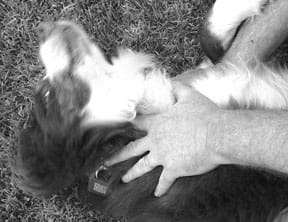 If you’ve ever watched certain dog training shows or read outdated training books, you might have come across the concept of the alpha roll. This technique involves physically forcing a dog onto his back and holding him there, supposedly to establish dominance and show the dog who’s the “alpha” (or boss) in the relationship. The idea is rooted in the now-debunked notion of dogs being like wolves in a pack, where a dominant “alpha” wolf would force subordinates into submission. For more on when and why this theory was debunked, check out this post here.
Why Do People Use the Alpha Roll?
Many people use the alpha roll because they believe it will establish their dominance over the dog, making the dog more obedient and less likely to “challenge their authority”. The alpha roll is often suggested by unqualified trainers as a way to correct behavior seen as aggressive, stubborn or defiant, based on the assumption that dogs need to understand who’s in charge. This method has been popularized by certain television personalities and outdated training philosophies that emphasize dominance and submission.
Why Alpha Rolls Are Harmful to Your Dog
It’s Based on Really Old, Flawed Science

The alpha roll concept originates from studies on captive wolves conducted in the 1940s by Rudolph Schenkel. He observed that wolves in captivity would sometimes engage in aggressive behaviors to establish dominance. However, later research by wildlife biologist David Mech in the 1990s overturned those findings. Mech’s studies on wild wolves revealed that wolf packs function more like family units, with parents guiding offspring rather than enforcing submission through force. Applying those captive wolf observations to domestic dogs was always a stretch, and the science has moved well past it
It Can Damage Your Relationship with Your Dog

When you alpha roll your dog, you’re not building respect or trust. You’re instilling fear. Dogs already rely on us for the simplest things in life, like when to eat, sleep or go out, or where and when to potty, they’re definitely not under any impressions of being the boss of you, despite what it might sometimes seem like!
They put their trust in us to take care of them and their needs, and subjecting them to alpha rolls can make them anxious and fearful of their guardians, damaging the bond that exists. Remember a fearful dog is less likely to trust you and more likely to exhibit stress-related behaviors, including avoidance and in some cases aggression.
It can escalate aggression, not reduce it
Instead of curbing aggressive behavior, alpha rolling can actually make it worse. Dogs may feel threatened and respond with increased aggression. The American Veterinary Society of Animal Behavior (AVSAB) has noted in their position statement on dominance theory that confrontational training methods, including alpha rolls, are associated with increased fear, anxiety, and aggressive responses in dogs. That’s right! Instead of sobering your dog down, you’re actually putting fuel in the fire, for a bigger explosion later on!
It can cause physical injury

Physically forcing a dog onto their back can harm muscles and joints, and in more extreme cases cause fractures and dislocations. Now you’ve got a dog that is frustrated AND in pain — a combination that most often produces exactly the behavior problems you were trying to resolve in the first place. And that’s before accounting for the risk of bites and scratches to you if the dog decides to resist.
If your dog is showing aggression during play or in other interactions with people in the home, you can read more about how I work with dogs who are aggressive toward people and what that process looks like here
What to Do Instead of an Alpha Roll
Gentler Play

Stop revving your dog up to the point of no return. Intersperse highly arousing play with calm periods to bring your dog back to a baseline before things tip over. Just like with kids, we need to be the responsible ones and watch for when positive play behaviors are about to cross a line, so we can stop it before it happens. You model your kids, and you model your dogs. If you’re calm and gentle in your interactions, your dog will follow eventually. You might need to ride out the adolescent years patiently first.
Don’t make a big deal out of it

If you find your play has crossed the line and your dog has lost the plot, raising your voice or exaggerating your movements, will only communicate to the dog that you’re also getting excited – Not what you want!

Instead, calmly get up and get them a high value long lasting chew toy (frozen Kong or Lickimat or Raw bone) and lead them to another room with it. Engage them with that, and once they’re engaged, leave them calmly to enjoy it. Come back and get them calmly once you feel calm yourself!
Teach them how to Channel their Excitement in Acceptable ways

Work with a certified trainer or behaviorist using positive reinforcement methods to teach your dog acceptable outlets for excitement. That’s right! You can teach your dog to redirect their excitement by going to get another toy to shake or shred, or run around with when they get to a certain point in their arousal. Pretty neat eh?
If your dog is showing aggression toward people in the home and you’re not sure what’s driving it or what to do next, learn more about how I help guardians whose dogs are aggressive toward people here. There’s usually a lot more going on beneath the surface than the behavior itself suggests.
To Wrap Up
 The alpha roll is an outdated, physically risky, and ineffective training method. Modern animal behavior research and every major professional organization are clear on this. The good news is that positive reinforcement training gives you better tools, a stronger relationship with your dog, and results that actually last.
References
American Veterinary Society of Animal Behavior (AVSAB) — Position Statement on Dominance Theory
RSPCA Australia — What is the RSPCA’s view on dominance dog training?