

If I had a cent for every time I heard a dog guardian say, “my dog would never bite” I’d be ready to retire on a lovely estate in Sentosa Cove!

I hate to be the bearer of some harsh truths, but:
ALL. DOGS. ARE. BITE. RISKS.
While its true that most pet dogs have extraordinary, uncalled for patience when it comes to their human companions (they seriously put up with A LOT), its also true that if pushed beyond a limit, even the most docile dog can be a biter.
 Its often the same guardians that had this unfounded confidence that their dogs would never bite, that find themselves saying “he bit me out of the blue!”.
It’s never “out of the blue”.
The Canine Ladder of Aggression: What Happens Before a Dog Bite
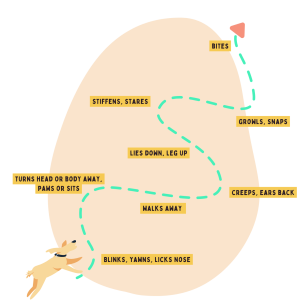
Most dogs need to be pushed beyond a certain limit before they resort to biting. If you are on the receiving end of a dog bite, or the guardian of a dog that has bitten someone unexpectedly, it’s likely that you missed all the earlier, lower-level signals of discomfort your dog was giving before escalating to a bite.
No dog goes from 0 to 100 without hitting all the numbers in between. Just like with humans.
Take the example of someone pulling your hair. At first you might politely ask them to stop. If they don’t stop, you might raise your voice. If they still don’t stop, you might push their hand away. Dogs operate the same way. Before escalating to a dog bite, they will display several lower-level signals: looking away, turning away, lip-licking, yawning, growling. Only when those are ignored does a bite become the next step.
The only time you’ll find a dog skipping those lower-level signals and going straight to a bite is a dog that has learned over time that humans ignore their earlier communication. Growling didn’t work. Lip-licking didn’t work. So now they go straight to what does. These are often the dogs that seem to bite without warning.
If your dog has made contact with a person in the past and you’re not sure what led up to it or where to go from here, you can read more about how I work with dogs who are aggressive toward people and what that process looks like here.
If your dog has just bitten someone and you need immediate next steps, start with My Dog Bit Someone! What to Do Next.
Why Learning Dog Body Language Can Prevent a Dog Bite
 We all know the serious trouble dogs and their guardians can get into if there has been a bite incident. Singapore laws and regulations are, rightly, very stringent when it comes to public safety.
As a responsible dog guardian, its imperative that you learn dog body language so that you know what your dog’s early signs of discomfort are. That way you can intervene before they feel the need to escalate their behavior towards a bite and potentially cost you a SGD 5000 fine!

Learning dog body language is like learning any new language. You need to practice it to become good at it. Practice involves simply being present and watching your dog when you or someone else interacts with them. Erring on the side of caution, and removing your dog from the interaction or situation when you notice an early sign of discomfort is better than waiting it out and pushing the dog too far into discomfort.
Initially it might seem like you’re guessing at what they might be communicating, but you’ll be surprised at how quickly you are able to figure out what your dog is saying if you consistently practice it for a week!
I offer a free Dog Body Language Guide because it’s that important for every dog guardian to understand what their dog is actually saying. The guide covers the full picture, with videos, images, and written explanations of what your dog might be communicating in different situations.
What Responsible Dog Guardianship Looks Like
Being a responsible and devoted dog guardian requires you to be proactive, attentive, and mindful.
Be proactive and learn dog body language before you need it. The guide is a good place to start.
Be attentive and put what you’ve learned into practice by staying present and watchful during interactions. Take action if you notice signs of discomfort, before things escalate.

Be mindful that yes, even your gentle baby is capable of a dog bite if pushed far enough. The fact that they haven’t been pushed to that point yet doesn’t mean it won’t happen.
If you can do all of the above, you are well on your way to keeping the Singapore public, yourself, and your dog safe.